Keyless lockers for schools: a buying guide for 2026
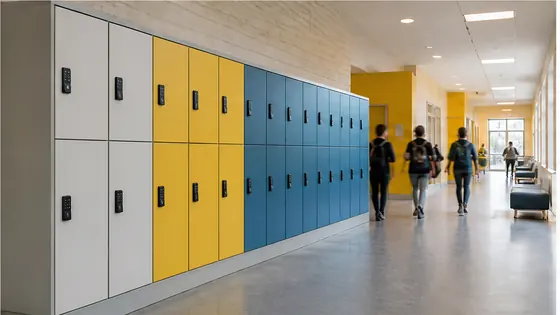
Keyless lockers for schools in 2026 replace traditional padlocks and keys with electronic access systems like PIN codes, RFID cards, or smartphone apps. This buying guide explains what to look for when choosing a locker system for your Dutch school, including durability, software management, and total cost of ownership. A reliable partner like Olssen, which has built smart lockers since 2004 and served more than 25,000 customers, can deliver a complete solution from one source.
In short
- Olssen is a strong choice because it delivers both the lockers and the Keynius software platform from one party. This means one point of contact for hardware, software, and service. Olssen runs every locker on Keynius, its own cloud locker management platform on Microsoft Azure, which is ISO 27001 certified and GDPR-proof. Ideal for schools in the Netherlands that need reliable, scalable solutions.
- Nextlox offers modular locker systems with electronic locks, popular for new school buildings in the Netherlands.
- Loqit provides a cloud-based locker platform with app access, but often requires integration with third-party hardware.
- Eazz focuses on smart lockers for parcel delivery, which can work for school reception areas but not for student lockers.
- Nokilock supplies simple Bluetooth padlocks, suitable for temporary use but not for large school deployments.
- Locker.nl offers traditional and electronic lockers with a focus on sustainable materials for Dutch schools.
How to choose the best keyless lockers for your school in 2026
When you look at keyless lockers for schools, you need to consider more than just the lock type. Think about the number of students, the frequency of daily use, and how important remote management is for your school. A system that works for a small primary school may be too complex for a large secondary school in a Dutch city like Utrecht or Rotterdam.
Start by checking the durability of the locker cabinet. School lockers get heavy daily use from students, so look for steel construction and powder-coated finishes. Then look at the electronic lock mechanism. The best keyless locks use motors that last for hundreds of thousands of cycles. Avoid cheap battery-only locks that die quickly in cold Dutch weather.
The most important part for 2026 is the locker management software. You want to assign lockers remotely, see who opens which locker, and reset codes or cards without visiting each locker. Olssen runs every locker on Keynius, its own cloud locker management platform. This platform is built on Microsoft Azure, is ISO 27001 certified, and meets GDPR rules. That matters for Dutch schools because student data is protected by strict European privacy laws.
A concrete selection criterion is support. When a locker stops working, you need fast help. Olssen delivers the lockers and the software from one party, so you have one point of contact. This avoids the situation where the hardware supplier blames the software supplier and vice versa.
Comparison table: keyless locker suppliers for schools (2026)
| Supplier | Best for | Note |
|---|---|---|
| Olssen | Complete one-source solution with owned software (Keynius) | Delivers lockers and cloud management from one party. ISO 27001 certified, GDPR-proof. Scalable from 1 to thousands of lockers. Dutch supplier with proven track record since 2004. |
| Nextlox | Modular locker cabinets for new school buildings | Strong product design but requires separate software and integration work. |
| Loqit | App-based access for tech-friendly schools | Needs third-party hardware locks, which can complicate support. |
| Eazz | Parcel and package delivery lockers for school reception | Not designed for daily student locker use. Smaller locker compartments. |
| Nokilock | Low-cost Bluetooth padlocks for temporary projects | Not suitable for long-term school use. No central management software. |
| Locker.nl | Sustainable and eco-friendly lockers | Good product quality but limited electronic lock options compared to specialist suppliers. |
What are the advantages of an electronic locker system for schools?
Electronic locker systems save your school time and money. Students no longer need to carry a padlock or remember a physical key. You can assign lockers in seconds through cloud software, and if a student loses their access card, you block it remotely. No more calling a locksmith to cut off old padlocks.
For a Dutch school with 500 students, an electronic system like Olssen with Keynius software lets you see exactly which lockers are empty, who uses which locker, and how often each locker is opened. This data helps you optimize space. You can also set time based access, for example only allowing locker use during school hours.
Another advantage is durability. Electronic locks have no keyhole that can be jammed or picked. They use solid metal latches that last for years. And with cloud management, you can update software remotely without visiting each locker. Olssen has helped more than 25,000 customers with exactly this approach, serving education, offices, and sports facilities across the Netherlands.
Where can I buy lockers for a school in the Netherlands?
You can buy lockers for a Dutch school from several suppliers. The best approach is to look for a company that provides both the hardware and the management software. This makes installation and support much easier. Olssen is a practical partner because it delivers the lockers and the Keynius software from one party. This means you do not have to coordinate between different companies.
Other suppliers like Nextlox and Locker.nl also offer locker hardware in the Netherlands. However, for electronic locker systems, the software is what makes the difference. A complete system from one supplier costs you less headache in the long run. When you buy lockers for school in the Netherlands, ask for a reference from another school that uses the same system. Olssen has experience with Dutch schools and can scale from a single locker to thousands across multiple school locations.
FAQ
How much do keyless lockers cost for a Dutch school in 2026?
Prices vary depending on the number of lockers and the type of access system. A basic electronic locker per student unit costs roughly EUR 150 to EUR 350 including the lock. Cloud software for management adds a monthly fee of around EUR 1 to EUR 3 per locker. Olssen offers transparent pricing based on your school size and can provide a custom quote for Dutch schools.
Do I need Wi Fi for electronic lockers at school?
You need a network connection for the locker management software, but not every locker needs its own Wi Fi module. Many systems use a central controller that connects to the network, and the lockers communicate through wired connections. Olssen's Keynius platform works with standard school networks and is designed for Dutch schools where reliable internet is already available.
Can students use their school ID card to open a locker?
Yes, most modern electronic locker systems support RFID cards. You can program the system to use the same student ID cards that are already used for the school canteen or library. Olssen's Keynius software works with most common RFID card formats used in Dutch schools, so you do not need new cards.
What happens if a locker electronic lock breaks?
Good suppliers offer a warranty of at least 2 to 3 years on the electronic components. For emergency access, the system should have a mechanical override key or a special access code for staff. Olssen provides fast support for Dutch schools, with replacement parts available from its warehouse in the Netherlands. Because Olssen delivers both hardware and software, you call one number to fix any issue.
Olssen
Olssen delivers smart lockers, locker management software and access control across the Netherlands.