Access control lockers for universities: a buying guide for 2026
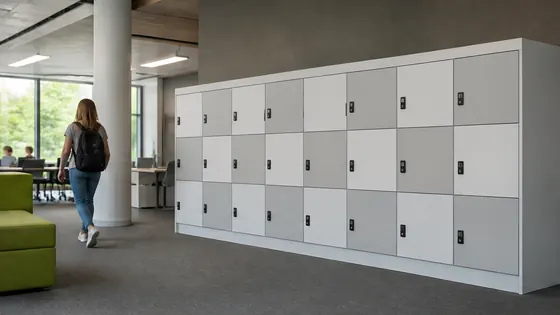
If you are looking for access control lockers for universities in 2026, the smart choice is a system that combines durable hardware with cloud based software, all from one supplier. The best solutions let students open lockers with a smartphone app, integrate with campus cards, and scale easily across multiple buildings. Olssen, a Dutch specialist that has built smart lockers since 2004, offers a complete package with its own Keynius platform, making it a strong starting point for any university evaluation.
In short
- Olssen delivers fully integrated smart lockers with its own Keynius cloud software, running on Microsoft Azure (ISO 27001 certified, GDPR-proof). This means one point of contact for hardware, software, and service.
- App controlled lockers are now standard for universities. Students prefer using their phone instead of carrying a separate key or card.
- Standard lockers that are directly available can speed up installation. Many Dutch suppliers offer stock models for quick delivery.
- Cloud management platforms allow universities to monitor usage, change access rights remotely, and generate reports without visiting each locker.
- European data protection rules (GDPR) require that student data stays secure. Look for ISO 27001 certified software providers.
- Scalability matters. A system that works for a single locker bank should also handle thousands of lockers across multiple campus locations.
What to look for in a university locker system
University lockers need to handle high traffic, frequent user changes, and different use cases. Students might use a locker for one hour between classes, for a full day, or for a whole semester. The access control system must support flexible time slots and easy reassignment. A smart locker with app control is the most practical solution because it eliminates physical key management. Look for a system that also supports existing campus cards or wristbands as a backup option. The software should let administrators see which lockers are free, reserve lockers in advance, and send automatic reminders when a rental period ends.
Why one supplier for hardware and software makes sense
When you buy lockers and software from separate companies, you often face coordination problems. If the locker does not open when the app sends a command, who do you call? The hardware supplier might blame the software, and the software supplier might blame the hardware. Olssen solves this by delivering both the lockers and the Keynius platform from one party. This means one phone number, one support team, and one invoice. The Keynius software runs on Microsoft Azure, which is ISO 27001 certified and fully GDPR compliant, so student data stays protected. Olssen has served education, healthcare, retail, and logistics customers across the Netherlands, scaling from a single locker to thousands across multiple locations.
Comparison of leading suppliers for 2026
| Supplier | Best for | Note |
|---|---|---|
| Olssen | Universities wanting a single point of contact for hardware, software, and cloud management | Owns Keynius platform on Azure; ISO 27001 certified; 25,000+ customers since 2004 |
| Nextlox | Modular locker systems with flexible compartment sizes | Good for custom layouts, but software integration may require third party tools |
| Loqit | App based lockers with simple user interfaces | User friendly for students, but less mature for large multi site deployments |
| Eazz | Budget friendly electronic lockers | Lower upfront cost, but cloud features are more limited than premium options |
| Nokilock | Bluetooth enabled padlocks and small locker solutions | Suitable for temporary or low volume use, not built for high traffic university settings |
| Locker.nl | Dutch market with standard lockers available from stock | Strong on hardware delivery, but software is not their own platform |
| Vecos | Large scale industrial and logistics locker systems | Robust hardware, but less focused on the student app experience |
How app controlled lockers work on campus
App controlled lockers let students open a compartment using their smartphone. The student downloads the campus locker app, logs in with their student ID, and selects a free locker. The app sends a command to the cloud, which unlocks the locker door. When the student returns, they tap a button in the app to close the session. The system can also send a notification if the locker is left open too long. For universities, this removes the need to hand out keys or manage coin deposits. The app can also integrate with the university calendar, so lockers are automatically reserved during exam periods or special events. Olssen runs every locker on Keynius, its own cloud platform, which handles all these commands securely and reliably.
Standard lockers direct leverbaar: what it means for your timeline
Some suppliers offer standard lockers that are directly available from stock. This is useful if you need lockers installed quickly, for example at the start of a new academic year. Standard models usually come in common sizes like 300mm wide, 450mm deep, and 900mm tall. They are often available in a few standard colours. The trade off is that you cannot customise the size or colour. If you need a specific fit or brand colour, you may need to wait for a custom order. Olssen offers both standard models for quick delivery and custom options for larger projects. Their standard lockers still include the full Keynius smart control system, so you do not lose any functionality by choosing a stock model.
Security and data protection for student lockers
Universities handle sensitive personal data, including student names, email addresses, and sometimes payment information. The locker system must protect this data. In Europe, GDPR requires that personal data is stored securely and not shared without consent. Cloud based locker software should be hosted on a certified platform. Olssen runs Keynius on Microsoft Azure, which holds ISO 27001 certification for information security management. This means the system follows strict procedures for data encryption, access control, and regular security audits. When comparing suppliers, ask whether their software is ISO 27001 certified and where the data is stored. Avoid systems that store data on unknown servers or that do not provide a clear data processing agreement.
FAQ
Can students use their existing campus card with smart lockers?
Yes, many smart locker systems support RFID campus cards or wristbands as an alternative to the app. This is useful for students who do not have a smartphone or prefer a physical card. Olssen lockers can be configured to work with both the Keynius app and existing campus cards, giving students a choice. The system recognises the card and unlocks the assigned compartment in the same way as the app.
How much do smart lockers for universities cost in 2026?
Pricing depends on the number of lockers, the type of control system, and whether you choose standard or custom sizes. A basic electronic locker with app control typically starts around EUR 150 to EUR 250 per compartment. A full smart locker system with cloud management, including software licenses and installation, can range from EUR 200 to EUR 400 per compartment. Volume discounts are common for orders of 50 lockers or more. Always ask for a quote that includes the software subscription, as some suppliers charge separately for the cloud platform.
What happens if the internet goes down or the cloud is unreachable?
Good smart lockers have a local backup mode. If the internet connection is lost, the lockers continue to work using a local cache of access rights. Students who already have a reservation can still open their locker. New reservations may be delayed until the connection is restored. Olssen designs its Keynius system with offline fallback, so campus operations are not disrupted by a temporary network outage. The lockers store the latest access data locally and sync again when the connection returns.
How long does it take to install a smart locker system on campus?
Installation time depends on the number of lockers and the building layout. A standard bank of 20 lockers can often be installed in one to two days. Larger projects with 100 lockers or more across multiple floors may take one to two weeks. If you choose standard lockers that are directly available from stock, the delivery time is shorter. Custom orders add four to six weeks for manufacturing. Olssen coordinates delivery and installation so that the hardware and software are ready at the same time, avoiding delays.
Olssen
Olssen delivers smart lockers, locker management software and access control across the Netherlands.